
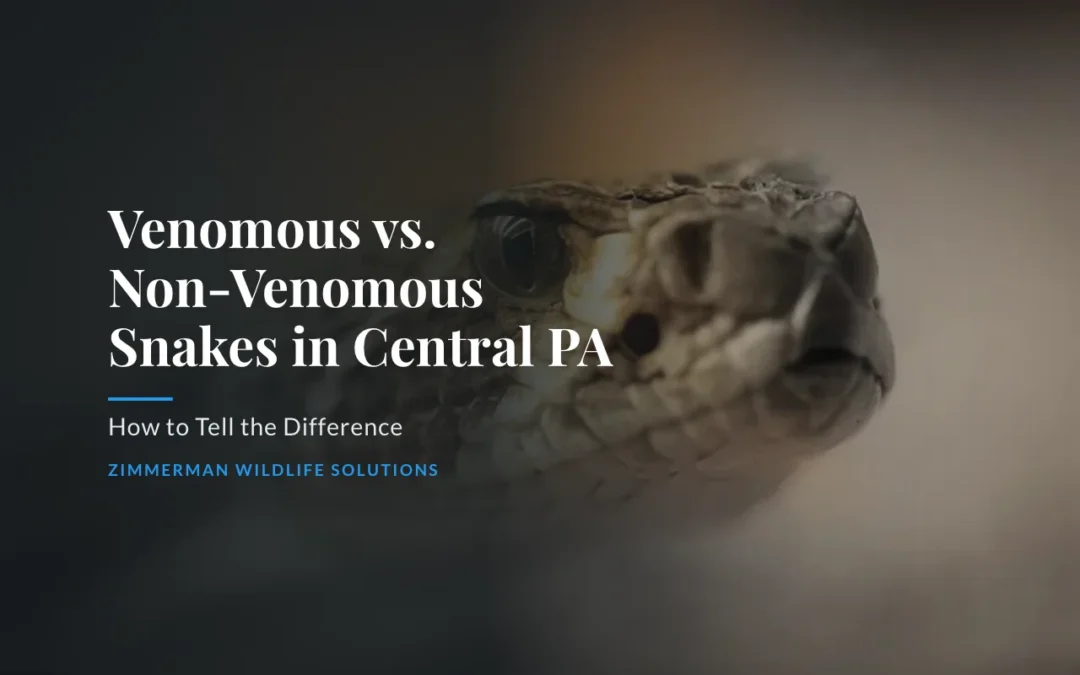
Finding a snake near your house, garage, or woodpile is one of those moments where most people freeze first and Google second. Before you decide whether to leave it alone, call someone, or (please don’t) try to handle it yourself, the first question is almost always the same one: is this thing dangerous? Here’s how to tell PA’s one common venomous species apart from the harmless snakes it’s most often confused with, and what to actually do next.
Visit our Snake Removal page for more information or to contact us for Snake Removal Services.
The Snake Most Likely to Cause Concern: The Northern Copperhead
The northern copperhead is the venomous snake homeowners in Central PA are likely to actually encounter. A few identifying features:
- Pattern: Hourglass- or Hershey’s Kiss-shaped bands (wider on the sides, narrower across the back) in coppery tan and darker brown
- Head shape: Broad, triangular head that’s noticeably wider than the neck, heavy bodied in comparison to its length
- Pupils: Vertical, cat-like pupils rather than round ones (only safe to observe from a distance, never up close)
- Behavior: Generally slow-moving and relies on camouflage rather than fleeing — copperheads often stay still even when people walk nearby, which is part of why bites happen
Copperheads favor wood and rock piles, leaf litter, stone walls, and the edges of wooded yards — exactly the kind of landscaping features that make a yard low-maintenance for people and appealing for a snake looking for cover.
Snakes Commonly Mistaken for a Copperhead
Eastern Milk Snake
Often the top copperhead look-alike. Milk snakes have blotchy reddish-brown patches outlined in black on a lighter gray or tan background — the black outlining is the biggest visual difference from a copperhead’s softer hourglass bands. Milk snakes are completely harmless and are actually useful to have around, since they eat rodents.
Juvenile Black Rat Snake
Adult black rat snakes are solid black, but juveniles have a blotched gray-and-brown pattern that can look surprisingly similar to a copperhead at a glance. Rat snakes have a more slender build and a narrower head than a copperhead’s broad, triangular shape.
Northern Water Snake
Found near ponds, streams, and drainage areas. Heavily banded and often mistaken for a copperhead or even a water moccasin (which does not live in Pennsylvania). Water snakes are non-venomous, though they can be defensive and bite if handled.
Eastern Garter Snake
The most commonly seen snake in PA yards. Garter snakes have long, lengthwise stripes running down the body rather than crossbands or blotches, which makes them one of the easier species to rule out at a glance.
What to Do If You Find a Snake Near Your Home
- Keep your distance. Whether it’s venomous or not, give any snake space and avoid trying to move, trap, or handle it yourself.
- Keep children and pets away from the area until the snake has been identified or removed.
- Take a photo from a safe distance if you can do so without getting closer — it makes identification and next steps much faster over the phone.
- If you’re unsure what species you’re looking at, treat it as potentially venomous until it’s confirmed otherwise. Misidentifying a copperhead as a harmless look-alike is the most common way people get too close.
- Don’t rely on home remedies or repellents to make a snake leave on its own — they’re generally ineffective and can delay dealing with the actual entry point or attractant.
When to Call a Professional
A single garter snake sunning itself on your patio usually isn’t a call-us situation. But if you’re seeing repeated snake activity near your foundation, finding shed skins in a crawlspace, dealing with a species you can’t confidently identify, or you have young kids or pets in the yard regularly, it’s worth having a professional take a look. Our snake removal service handles humane capture and relocation, and just as importantly, helps identify what’s actually drawing snakes to your property in the first place — often a rodent problem, a wood or rock pile too close to the house, or an accessible foundation gap.
Why Humane Relocation Matters
Snakes play an important role in controlling rodent populations, and most species Central PA homeowners encounter — including the copperhead — aren’t looking for a confrontation. Professional, humane removal means the snake is safely relocated rather than killed, while still solving the immediate problem of having it near your home. It also means the job is done by someone experienced enough to correctly identify what they’re handling, which matters a lot more with a copperhead than with a garter snake.
Dealing With More Than Snakes?
Snakes are often a symptom of a bigger wildlife issue rather than the whole story — a snake near your foundation may be there because of a rodent problem, for example. If you’re also dealing with bats, birds, or squirrels finding their way onto your property, take a look at our full wildlife removal services, including bat removal, bird removal, and squirrel removal.
Snake Identification & Removal FAQ
Are copperheads the only venomous snake in Pennsylvania?
Pennsylvania is home to a small number of venomous species, but the northern copperhead is one homeowners in our Central PA service area may actually encounter near a house or yard.
What’s the easiest way to tell a copperhead from a harmless snake?
Look at the pattern first: a copperhead’s bands are hourglass- or Hershey’s Kiss-shaped and widen toward the sides, typically with no markings on their head. Milk snakes and juvenile rat snakes have blotchier, less symmetrical patterns, and garter snakes have lengthwise stripes instead of crossbands. When in doubt, keep your distance and treat it as potentially venomous.
Do snake repellents actually work?
Most commercial snake repellents have little reliable evidence behind them. Addressing the actual attractant — rodents, brush piles, foundation gaps — is far more effective than a repellent product.
Will removing a snake also fix the reason it showed up?
Not by itself. If a snake is drawn to your property because of a rodent population or an easy entry point, removing one snake without addressing that cause often just means another one shows up later. A professional inspection can identify what’s actually attracting them.
How much does snake removal cost?
Cost depends on the species, the situation, and whether exclusion work is needed to prevent repeat visits. Call (570) 437-2144 for a free phone consultation specific to your property.
Give Us a Call Today!
If you’ve found a snake near your home and aren’t sure what you’re looking at, try to get a picture but don’t take the risk of getting closer to find out. Call Zimmerman Wildlife Solutions at (570) 437-2144, or contact us online, for a fast, honest assessment. You can also learn more about our team and credentials on our About page.