
As the snow melts and the weather finally begins to warm up across Central Pennsylvania, homeowners start throwing open their windows to let the fresh air in. Spring is a season of renewal, but for local homeowners, it also marks the beginning of something much more stressful: the spring wildlife boom.
If you have recently started hearing scratching, thumping, or high-pitched chirping noises coming from above your ceiling, you might assume a stray animal has simply wandered inside to escape the lingering spring chill. Your first instinct might be to run to the local hardware store, buy a wire cage trap, and handle the problem yourself.
However, during the months of March, April, and May, those noises in your walls or attic rarely belong to a solitary animal. It is maternity season, which means you are likely dealing with a mother and her litter of babies. Handling this situation incorrectly can lead to catastrophic damage to your home, horrific odors, and serious dilemmas.
Don’t risk leaving helpless wildlife behind in your walls to cause expensive damage. > Dealing with an animal family in your attic requires specialized professional care. Contact our certified experts at Zimmerman Wildlife Solutions today at (570) 437-2144 for removal and to repair the damage.
The Reality of Spring Attic Noises
When nuisance wildlife enters a residential property during the spring, they are almost exclusively looking for one thing: a safe, warm, and secure place to give birth and raise their young. Attics, soffits, and wall voids mimic the natural hollow trees these animals seek out in the wild. Unfortunately, your home offers far better protection from natural predators and the harsh Pennsylvania elements.
To properly understand the threat, it is crucial to know which animals are most active during this time of year.
The Common Spring Invaders
- Raccoons: Female raccoons are incredibly resourceful and surprisingly strong. They can easily tear off roof vents, pry open soffits, or rip through weakened shingles to gain entry. Raccoons typically have litters of three to five “kits” in early spring. Because raccoons are larger animals, a mother raccoon will heavily trample insulation and create designated latrine areas in your attic, which poses a severe health hazard.
- Squirrels: Gray squirrels actually have two breeding seasons in Pennsylvania—one in the late summer, and a major one in early spring. Squirrels in your attic are notorious for their chewing habits. A mother squirrel building a nest will shred your fiberglass insulation and, dangerously, gnaw on electrical wiring, creating a massive fire hazard hidden entirely from view.
Both of these species are highly maternal. The mothers will go to extreme lengths to protect their young, making them unpredictable and sometimes aggressive if confronted in a confined space like a crawlspace or attic.
The Disaster of “DIY Trapping” During Maternity Season
The internet is full of misguided advice on how to trap nuisance animals. For a homeowner experiencing sleep deprivation from nighttime scratching, the quick fix of setting a trap in the yard or near the roofline seems appealing.
This is where the nightmare truly begins.
Let’s look at the standard “DIY” trapping scenario during the spring: A homeowner sets a trap baited with peanut butter outside the home. The mother raccoon or squirrel, exhausted and hungry from nursing her young, is lured in and captured. The homeowner, feeling a sense of victory, relocates the trapped adult animal a few miles down the road. They assume the problem is solved.
Here is the grim reality of what actually happens next:
- The Abandoned Litter: By trapping and removing the mother, you have just orphaned an entire litter of young hidden deep within the structure of your home. These juveniles are entirely dependent on their mother. They are blind, immobile, and need to be feed.
- The Noise Escalates: As the babies grow hungry and dehydrated, they will begin to cry. For raccoons, this sounds like a loud, persistent chattering or bird-like chirping. This noise can go on for days, causing intense distress for anyone living in the house.
- The Costly Aftermath: Eventually, the abandoned juveniles will perish inside your walls or under your attic floorboards. Within a matter of days, the decay process begins. The resulting odor is unimaginable and will permeate the drywall, leaking into your living room or bedrooms.
- Structural Damage to Resolve: Once a dead animal is in your wall void, simply masking the smell with air fresheners will not work. The only way to resolve the biohazard and the smell is to hire a professional to cut open your drywall, extract the deceased animals, sanitize the space, and then hire a contractor to repair and repaint your walls.
What started as an attempt to save a few dollars on a trap has now escalated into a massive structural repair bill, a severe health hazard, and a deeply inhumane outcome for the animals.
This is exactly why searching for humane wildlife removal in Lewisburg PA (or anywhere in the Central PA region) is critical. A certified wildlife control operator knows that during the spring, a trapped female means there is more work to be done.
The Professional Humane Solution: A Start-to-Finish Process
At Zimmerman Wildlife Solutions, we take a fundamentally different approach. Our team is led by a Certified Wildlife Control Professional (CWCP), and we have spent over 20 years in the field learning the behavioral patterns of Central Pennsylvania’s wildlife.
When you call us for spring noises in your attic, we operate under the assumption that babies are present until proven otherwise. Here is how proper, humane wildlife removal should be executed:
Step 1: Comprehensive Property Inspection
Before a single trap is set, we perform a thorough interior and exterior inspection. We look for the main entry point, examine the type of damage (which tells us what species is present), and visually inspect the attic space to try to locate the nest.
Step 2: Safe Extraction of the Litter
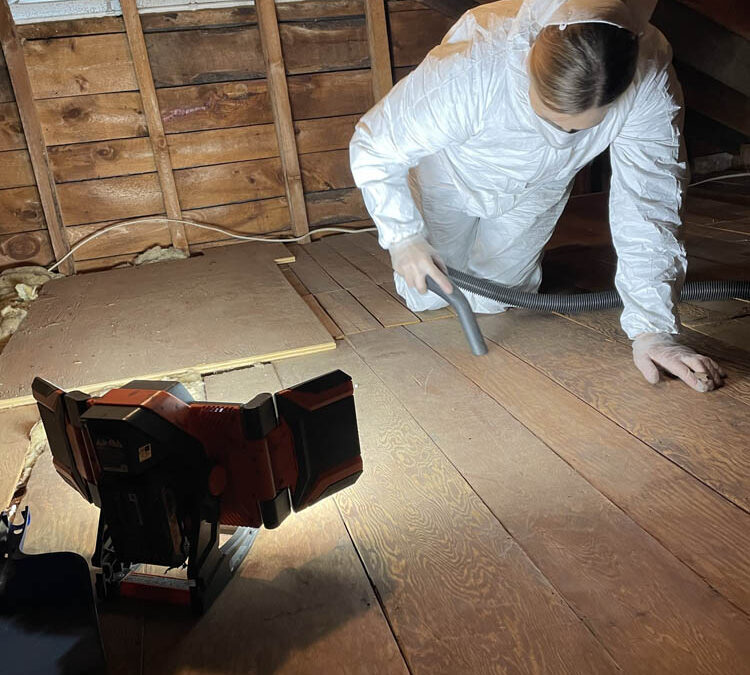
Once the nest is located, the priority is safely extracting the young. This is often a delicate process that requires protective gear, proper respiratory equipment (due to the presence of feces and contaminated insulation), and a gentle hand. The babies are carefully removed and secured.
Step 3: Evicting the Mother
With the babies safely secured, the mother is much more predictable. Often, she can be safely flushed out of the attic space, or we can use the young as an attractant to trap her.
This process clears your home of the infestation without risking deceased animals in your walls.
Why Patching a Hole Isn’t Enough: The Importance of Exclusion
Once the wildlife is removed the job is still only half finished.
Many homeowners make the mistake of having an animal removed and then simply nailing a piece of plywood over the hole, or stuffing the gap with steel wool. Unfortunately, wildlife is persistent.
When animals live in a space, they leave behind pheromones and scent trails. These scent markers essentially advertise your home as a viable, safe living space to every other passing raccoon, squirrel, or bat in the neighborhood. If that entry point is not professionally sealed, a new animal will inevitably break in and claim the territory.
Professional Grade Repairs
To permanently protect your property, you need professional-grade repair and exclusion services. Because our crew has a diverse construction background alongside our trapping expertise, we don’t just “patch” holes; we fortify your home.
- Custom Metal Flashing: We bend and install custom metal to seal off vulnerable roof returns and fascia boards where squirrels love to chew.
- Ridge Guard Installation: As certified Ridge Guard installers, we can protect your roof’s ventilation systems from being compromised by determined pests.
- Heavy-Duty Vent Covers: We replace flimsy builder-grade plastic vent covers with heavy-duty metal barriers that animals cannot rip off.
By investing in proper exclusion, you stop the cycle of recurring infestations. It is an upfront investment that saves you thousands of dollars in future damage and removal fees.
Protect Your Home and Preserve the Wildlife
Discovering that you are sharing your home with a family of wild animals is undoubtedly stressful. But acting out of panic can turn a temporary nuisance into a permanent, costly disaster. Trapping is not a one-size-fits-all solution, especially when mother nature is in spring maternity season.
By choosing an expert who specializes in wildlife removal in Danville PA and surrounding communities that you can rely on, you are ensuring the safety of your family, the structural integrity of your home, and the ethical treatment of our local ecosystem.
Stop the cycle of recurring infestations and protect your property the right way.Don’t wait until the damage escalates or odors take over your home. If you suspect an animal is nesting in your attic, call the experts with over 20 years of local experience. Contact Zimmerman Wildlife Solutions today at (570) 437-2144 or reach out online to schedule your thorough property inspection and pest-proof your living space for good!